The Hormuz Blockade: The energy and supply chain crisis that's upon us

We are sleepwalking into the worst energy crisis since the 1970s. The Strait of Hormuz has been closed for 34 days now, and with it the world’s supply of 20% of oil and gas, 30% of fertilizer, 33% of helium and 10% of aluminium, among other critical materials.
Brent Oil is already at all-time high, but we haven’t priced in the effects nor have governments reacted. Shortages and high prices around the world are likely to come next. Restrictions have already started in some countries. To give perspective of the depth of the situation, the US had to rush to lift sanctions on Russian, and even more shockingly, Iranian oil.
Our Covid moment
This is just like covid in January 2020. But this time it’s not a novel virus that we don’t know if it’ll kill us all and spread like a plague, or just a flu that’ll go away. This time we have the rare benefit that we know what’s coming: the shortage of the fuel we’ve relied on for 100 years, and many other key raw materials. I think people will start to react when leaders around the world start to issue warnings and limitations to lifestyle, as we’re already seeing in New Zealand and Australia. It is our own responsibility to be prepared.
But it also feels opposite in a way. During the pandemic oil traded negative because there was such demand destruction, now high prices are the ones pushing the destruction.
Limiting trade
It’s likely that Trump, and other world leaders, will attempt to close exports to protect local consumers. But the US will need imports anyway. The argument “the US doesn’t need the Middle East because it’s an oil exporter” is such an oversimplification that in practice is false. The US does not have capacity to refine its own oil1. So it needs to import. But at a time where everyone is trying to guarantee its own supply, banning oil exports could mean countries stop exporting gasoline and other refined fuels to the US as retaliation (or just to guarantee its own domestic supply), which would further complicate things. Export bans could even happen without retaliation, during the beginning of the pandemic Turkey seized cargo bound to Spain.
Should exports be banned, that wouldn’t really have an impact in local prices for gasoline, as the US imports a big portion of its supply, and would probably lead to oil wells being underutilized, a loss-loss scenario. Given recent American erratic commercial policy, it’s hard to rule this (or anything) out. As soon as he got to office, Trump was already threatening partners with a trade war during peacetime, imagine how that would escalate in case fuel exports to the US are questioned.
Regardless, even if supply is guaranteed, the fact that we have these conversations in the first place, like they are already having in Australia, is a sign something is not right.
Liquefied Natural Gas (LNG) in the US will most likely be unaffected, as the US was already maxing out its export capacity even before the conflict.
What happens if fuel prices go up significantly and stay there for a while?
Prices will go up as we use fuel for everything, most notably transportation and food.
Shipping will get more expensive, and it will hurt every price of the economy, and especially e-commerce delivered by plane. For people not needing to commute to work, moving out of the cities may sound attractive. However, this time the supply chain is a constraint, the farther out you are, the more expensive things will be and the more risk of shortages. This may be the final push for online work as a standard.
Helium is an essential input for manufacturing chips and semiconductors. Just like Covid, computers and devices will be in need as workers go remote, but this time will not only be that the supply chain is constrained, but chip manufacturing itself could be affected.
And then comes food. If diesel is expensive, assuming there’s availability, and fertilizer supply is compromised due to the Hormuz blockade, some crops are just not going to be profitable or viable to sow and harvest. It could be that the farmers that are harvesting outbid the ones planting and the next season is actually the one hurt. Argentina is already feeling the pain.
In any way, prices for food will most likely go up, and that will unfortunately push people below the poverty line, or even famine. It’s worth noticing this was theorized during the beginning of the Ukraine war as Ukraine is one of the biggest grain exporters and Russia the biggest exporter of fertilizer. But this time, Ukraine is nowhere near out of the woods yet, and we get a double hit: fertilizer and fuel, with Russian oil widely sanctioned.
Also, over 130 container ships are stuck in the gulf, which will make a covid-like supply chain crisis worse. Container ship availability was a factor during the pandemic, and that assumes they are able to get fuel to move, as bunker fuel prices have skyrocketed. Risk for this is still low as the problem before the conflict was container ship overcapacity.
Refineries around the world will be at full capacity, with the most critical output being diesel. As all other fuels are distilled at the same time, we will have jet fuel as a byproduct. Plane travel will be possible, but much more costly. As we have more important things to worry about, I’d assume people will travel less, or not go to places for fear they won’t have gasoline to move around at their destination, or fear of not being able to come back altogether.
While many carriers are protected against price spikes through future contracts, these do not guarantee physical supply. Booking travel in advance may not be the solution to front-run airfare hikes either, because if fuel is not available, the plane won’t take off. In some extreme scenarios, this may be the final hit to airlines in distress. Long-haul travel will particularly be hurt as the fuel usage is not linear (for comparison, a 3 hour flight takes 18t of fuel, while a 12 hour flight takes 144t, 8 times more for 4 times the distance).
Collective delusion
Across the media, and especially on Wall Street they are running under the illusion that if the US really wanted to end this conflict and make everything come back to normal, they could do it overnight. As comforting as that sounds, this is not the reality. The Strait is not opening anytime soon and nobody really knows what to do to open it. The genie is out of the bottle, Pandora’s box is open and we need a sign of genius to get it back. So far we have only seen signs of mental illness come out of the administration.
It is hard to accept the reality that, even with a military power overwhelmingly superior to any country in the world, the United States does not have full control over an evil regime with a failing economy. It’s a hard pill to swallow.
Can the strait be fixed?
Not really, without Iran cooperation. Iran’s coastline along the strait is about 1200 km (745 miles) long. If there’s a threat that a single drone will be launched from there, ships will not sail. Imagine being a captain of a $100M tanker, fully loaded with gas. That’s essentially a giant floating bomb. Unless you’re 100% sure you’ll make it safely, it’s a no-go. Securing all that coastline is just too difficult, and no matter how many assets get deployed, full security cannot be assured. Iran has even been able to hit and halt oil ports far outside the strait, in UAE and Oman. “allies”2 have already rejected participating in the efforts, with some French officials even calling it impossible. If the US thought that using military force to control the Strait, or the strategic Kharg Island would result in free-flow of goods, they would have done it already. It’s not even clear those would be considered even as a last resort.
Assuming we do have military escorts for every ship, it’s extremely impractical and expensive, but also a recipe for escalating tensions: all the world’s navies will be operating in close range of each other while responding to threats. Even if it works, the risk associated with each barrel skyrockets, nobody can guarantee they’ll get the barrel they already paid for out. The costs and risks would be so massive that’s highly unsustainable.
Iran has already set up a tollbooth for ships and it’s moving to challenge US power by claiming sovereignty of the whole Strait. Trump is apparently losing his mind over this. And the fact that the US has fired high-ranking senior military officials is not a good sign either. And even if the Strait opened today, there’s already more than a month’s worth of cargo that has not been delivered.
What about markets?
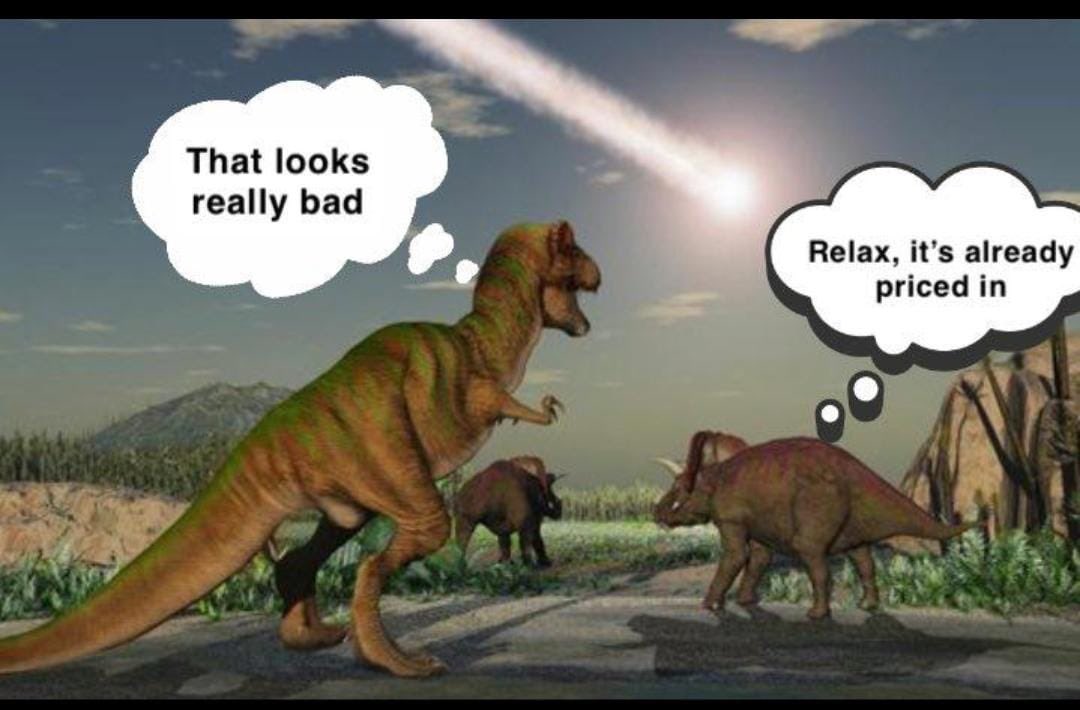
As inflation spikes, the textbook suggestion is to hike interest rates, and with that putting pressure on the price of every traded asset. But that recipe is mostly tested for monetary problems, not a supply problem. No matter how high the interest rate gets, the amount of fuel will be the same. Raising rates could even cool down a slowed economy given fuel prices. How central banks would react to high fuel prices is uncharted territory.
All this, of course, is terrible for AI investment. When asset prices go down, we will find out what bank was overleveraged, like we did in the 2023 banking crisis. Given all this I’d expect this would not simply be a dip to buy, but rather a mid-to-long-term impact to companies’ profitability. And the reader can take their own conclusion about airlines stocks, although travel overall is more nuanced: people will have less money to travel, but destinations near urban areas may benefit. This would be good for AirBnb, a company that was able to ride the covid pandemic and IPO before it ended. Airlines that have a hub-and-spoke model where they allow long travel with a stop in the middle would benefit, especially if they are based in a place where supply of fuel is abundant, like Copa Airlines.3
I would expect stocks related to electrification and trains to benefit from this, although in the short term they would probably also be affected by panic selling.
There’s also the question about real estate, as people spend more of their resources to cover basic needs. One would expect prices to go down. On the other side, construction will get more expensive and financing harder. To me, it is still an open question.
Can the US just leave?
No. As mentioned earlier, the Strait is essential to the US. If the US leaves, their internal market will be hit by sky high prices and their allies in the Gulf will be extremely vulnerable. There are US-flagged ships in the Gulf that’d be stuck there indefinitely.
“Trump is not going to allow it”, but he has recently both said that the US doesn’t care about the Strait and also that the Strait should be open ASAP. Both showing the US does not see it as feasible to open it with force in the short term. Not even the US Navy is operating inside the Persian Gulf.
What happens if a modern economy runs out of fuel?
It varies from country to country. In California or Spain, the grids are mostly run on non-fossil fuel sources. Spain electricity even consistently posts negative prices for wholesale. This means that in these economies electricity supply would not be affected, but prices will certainly go up as people prioritize Electric Vehicles (EV) and shut down their high cost fossil fuel sources of electricity. Even if electricity hasn’t gone up yet, the Spanish Government has already moved to lower tax for consumers.
This would cause a new kind of crisis. High-speed trains will still run and be at full capacity, but diesel trucks will get considerably more expensive. Downtowns with electrified transportations will become more important than ever, they would be even cheaper (compared to alternatives) to reach. Electric trains could also be used to ship food and goods in case of need, making cities more resilient. EVs demand could skyrocket and prices rise, especially considering that top manufacturers have been taking write-offs to scale down EV production.
Assuming diesel is available, prices will go up so much that I’d expect train capacity to be fully utilized to save costs, with trucks being used mostly for last-mile deliveries.4
In the places where electricity is supposed to be OK, places connected to trains will become even more important hubs.
So, what do we do?
It’s a good time to be prepared for food or electricity shortages. It is a good idea to have extra supply of food, water and electricity and an emergency kit. The cost of these is minimal, and most likely you’ll end up using them anyway eventually. Even if your grid is not fossil fuel dependent, big shifts in production are not rehearsed at scale and can lead to temporary grid failures. This has already happened in Spain and Texas in normal times.
Don’t let this crisis catch you off guard. Avoid putting yourself in situations where you’d be at risk, like relying on a single source of fuel or traveling to the other end of the world.
We will probably be forced to experience a lot of what hard-core environmentalists proposed, and how society reacts will be the ultimate test of whether those policies would be tolerated. I’d expect a push for drilling across the world, even if not profitable, just to have a strategic source of fuel. We may even see countries come back to nuclear energy, try to speed-run their plans or postpone shutdowns.
This post is not financial advice nor it tries to achieve the impossible task of predicting the future, it is a highly speculative piece meant as a thought exercise of what would happen if fuel supply remains constrained for long.
Predictions are very hard, especially about the future.
— Niels Bohr
Most US refineries were built in the 1970s-80s to process heavy, sour crude from Venezuela and the Middle East. After the shale boom, the US began producing abundant light sweet crude, but over 60% of refinery capacity remains optimized for heavy crude. Retrofitting would cost billions, so the US continues importing heavy crude while exporting excess light crude. ↩
It’s hard to call them European allies when the administration actively calls them cowards, ungrateful and threatens to invade them. ↩
Copa allows connections between South and North America via its hub in Panama, which also happens to be where the Panama Canal is, a major hub for fuel shipping. The airline is already one of the most fuel-efficient. ↩
Freight rail is roughly 3-4x more fuel-efficient than trucks per ton-mile. ↩
Enjoyed this post?
Subscribe to get new posts by email.